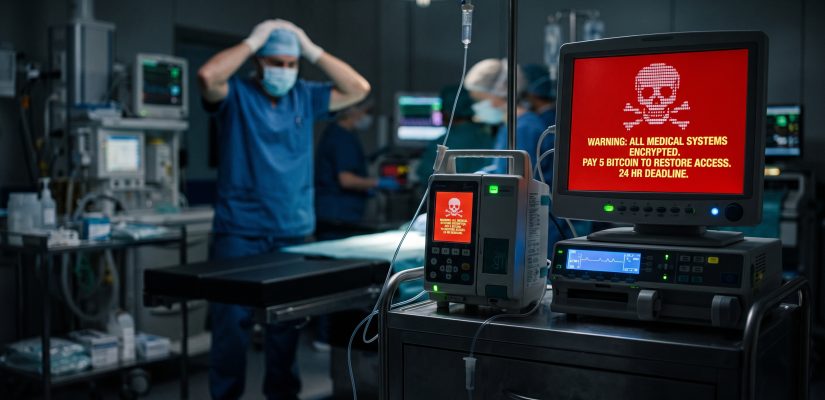
Clinical Infrastructure is a Death Trap: The Medical IoT Nightmare

There is a terrifying double standard in the cybersecurity industry. If a bank’s trading platform is compromised, it is a financial disaster. But when a hospital’s infrastructure is crippled by ransomware, we are gambling with human lives. Yet, despite these apocalyptic stakes, clinical IT is frequently managed with the same casual negligence as a mid-sized accounting firm.
The harsh reality is that modern clinical infrastructure is a digital death trap, and the primary culprits are flat networks and the Medical Internet of Things (IoT).
The Flat Network Delusion
Walk into almost any hospital today, and you will find a catastrophic architectural failure: the flat network. In an effort to make data seamlessly accessible to doctors and administrators, IT departments have connected everything to everything.
This means the receptionist’s computer—which is actively receiving hundreds of external emails a day—is sitting on the same routing fabric as the MRI machine, the digital X-ray, and the networked infusion pumps in the ICU. When an exhausted nurse clicks on a phishing link, the ransomware does not just encrypt the administrative files; it pivots laterally across the flat network and annihilates the clinical OT (Operational Technology).
You cannot run a hospital if the diagnostic imaging goes dark and the lab results cannot reach the emergency room. Patient diversion—rerouting ambulances to other facilities—kills people.
The Vendor Stranglehold on Legacy Systems
When security architects demand that hospital IT patch their systems, they hit a bureaucratic brick wall built by the medical device manufacturers.
Hospitals are overflowing with million-dollar medical devices running on obsolete, unsupported operating systems like Windows 7 or even Windows XP. When you ask the vendor for a security patch, they refuse, claiming that modifying the software would void the device’s medical certification.
This leaves hospitals in a permanent state of vulnerability. They are forced to operate highly critical, life-sustaining equipment that is entirely defenseless against modern exploits.
The Air-Gap Imperative
You cannot fix this with a new antivirus agent. You cannot fix this with a standard ITIL incident response process designed for lost passwords.
If you are running a clinical environment, you must assume the administrative network will be breached. The only survival strategy is brutal, uncompromising network segmentation. Medical IoT and clinical OT must be ruthlessly isolated behind strict firewalls and, where possible, completely air-gapped from the office IT and the public internet.
Stop treating patient telemetry like standard office data. If you refuse to segment your clinical networks, you are not just risking a data breach—you are risking a body count.
Appendix: The Hard Reality (Recent Medical IT Precedents)
- The Absolute Clinical Paralysis: Ascension Health Ransomware Attack (May 2024, USA). Ascension, one of the largest private healthcare systems in the US operating 140 hospitals, was crippled by Black Basta ransomware. The attack forced hospitals to divert emergency ambulances, shut down electronic health records (EHR), and cancel elective surgeries. Doctors were forced to rely on paper charts and manual drug dispensing for weeks.
- Supply Chain Contagion: Change Healthcare / UnitedHealth Group (February 2024, USA). The ALPHV/BlackCat ransomware syndicate breached Change Healthcare, a central processor for medical billing and data. The breach didn’t just affect one hospital; it caused a nationwide cascade failure. Pharmacies couldn’t verify prescriptions, and hospitals lost their primary cash flow, highlighting the lethal vulnerability of centralized, poorly segmented medical networks.
- European Infrastructure Breakdown: CHU de Rennes & Hospital de Versailles (2022/2023, France). A wave of targeted ransomware attacks on French clinical infrastructure forced multiple major hospitals to entirely cut their internet connections and isolate their internal networks. Patient data was inaccessible, surgical machines could not sync, and critical care patients had to be physically transferred to other facilities in the region to ensure their survival.
