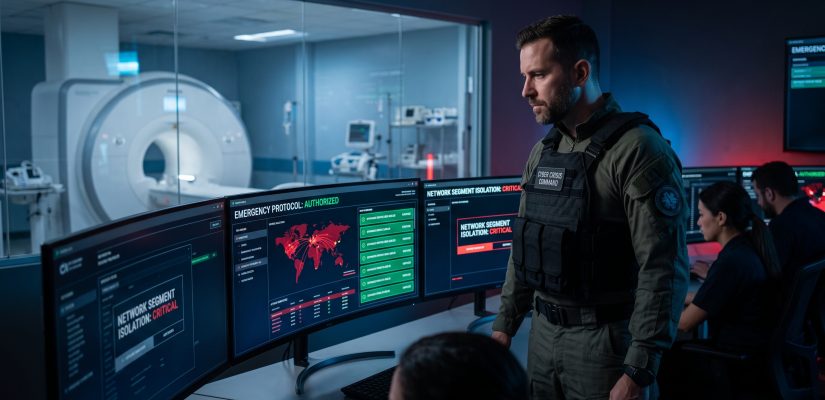
Modern Incident Management: Surviving the Worst-Case Scenario in Critical Infrastructure

.
.
.
When a ransomware syndicate breaches a manufacturing plant, it is a massive financial disaster. But when that same attack hits a hospital or critical infrastructure (KRITIS), we are no longer just talking about downtime and lost revenue. We are talking about patient safety, disrupted emergency care, and potentially life-or-death situations.
Despite these high stakes, the incident management processes I frequently encounter in clinical environments are dangerously unsuited for a severe cyber crisis.
The core issue lies in a misunderstanding of established frameworks. Most healthcare IT departments rely heavily on ITIL for their service management. ITIL is fantastic for maintaining order, managing changes, and handling standard IT incidents like a broken printer or a forgotten password. However, standard ITIL incident management is inherently bureaucratic. It relies on ticket queues, tiered support levels, and hierarchical approvals.
When you are under a targeted cyberattack, speed is your only currency. If a security analyst has to open a standard priority ticket and wait for a department head to approve the isolation of a compromised medical network segment, the war is already lost. The attacker will have encrypted the core databases before the ticket even reaches the second support tier.
Process Optimization: Decoupling Security from the Service Desk
To survive the worst-case scenario, you must optimize and separate your cybersecurity incident management from your daily IT operations. A cyber crisis cannot be managed out of a standard Jira or ServiceNow queue by the same people resetting passwords.
The strategy requires a specialized, streamlined workflow that bypasses standard bureaucracy when critical triggers are hit. You need a predefined, authorized rapid-response protocol. When a high-severity alert is verified—for instance, lateral movement detected near patient data systems—the standard rules must instantly be suspended.
The Step-by-Step Guide: Hardening Your Incident Management
Here is the blueprint for optimizing your incident processes for the real world:
- Step 1: Define the “Defcon” Triggers Clearly define what constitutes a standard IT incident versus a critical security crisis. A single malware detection on an isolated workstation might be standard. Concurrent suspicious logins on domain controllers and clinical backend servers must immediately trigger the worst-case protocol.
- Step 2: Establish the Crisis Authority During a major incident, the incident commander must have the absolute, pre-approved authority to make drastic decisions—such as taking a critical clinical subnet offline—without waiting for a committee or the hospital board to convene.
- Step 3: Secure Out-of-Band Communication If your Active Directory is compromised, your corporate email, MS Teams, and VoIP phones are dead or, worse, monitored by the attackers. You need a predefined, secondary communication channel (e.g., secure, isolated messenger apps on dedicated devices) to coordinate the defense.
- Step 4: Develop and Drill Actionable Playbooks Do not rely on a generic 50-page incident response policy. You need specific, technical playbooks for the most likely scenarios (Ransomware, Data Exfiltration, Compromised Admin Credentials). These playbooks must be drilled relentlessly with the technical teams.
- Step 5: Integrate External Responders Smoothly Your internal team will be exhausted after 12 hours. Ensure your external incident response retainers are seamlessly integrated into your workflows. They need to know exactly how to access your environment, who the technical leads are, and what the network topology looks like before the attack happens.
Conclusion
In critical infrastructure and healthcare, hoping for the best is not a strategy. You cannot fight a highly automated, aggressive cyber threat with slow, bureaucratic ticket systems. By optimizing your IT processes and granting clear, pre-approved authority to your defenders, you buy the one thing that matters most during a breach: Time.

Recent Comments